
Pollen morphology of representative taxa from “Varahicacos” Ecological Reserve, province of Matanzas, Cuba
Article Sidebar
Main Article Content
Abstract
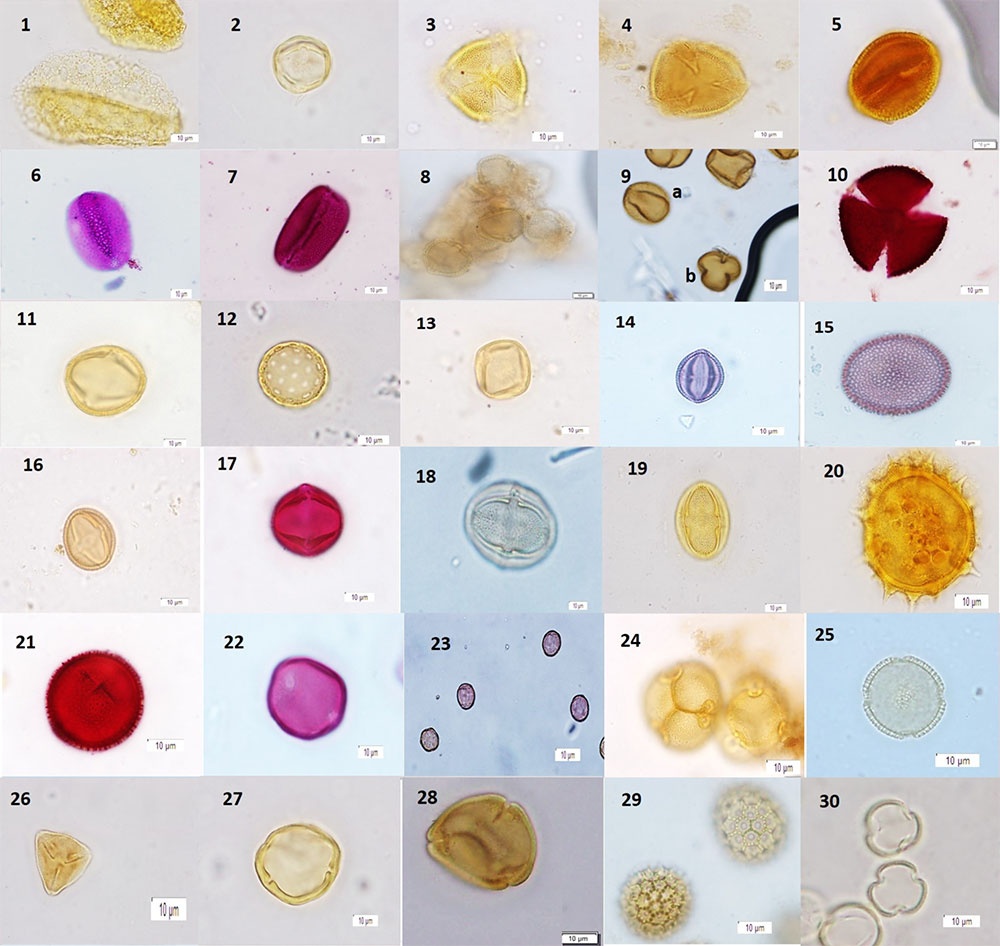
Palynology, as a basic and applied science, has shown its application in various areas of human knowledge. Due to the importance of palynological research and the need to extend its study to new taxa, the objective of this research was to perform the pollen characterization of taxa that characterize the plant formations of the “Varahicacos” Ecological Reserve, Matanzas, a town that treasures high natural and socioeconomic values. The pollen morphology of 30 species, corresponding to 20 botanical families and 27 genera, was described. Qualitative and quantitative variables were evaluated to characterize the grains; descriptive statistics were calculated and the statistical significance of the differences between species belonging to the same genus was evaluated. The results showed a great variability of the pollen morphology. The locality was characterized by presenting more frequently pollen grains: monads (96.6%), isopolar (66.6%), radiosymmetric (83.3%), circular scope (80.0%), medium size (60.0%), spheroidal (30.0%), colporate (43.3%) and reticulate (43.3%). The statistical analysis carried out constitutes one of the fundamental tools of this research, allowing to refute old considerations and ratify the discriminatory power of the pollen characteristics up to the specific level.
Article Details
Section

This work is licensed under a Creative Commons Attribution-NonCommercial 4.0 International License.
How to Cite
References
Carranza-Quinceno JA, Estévez-Varón JV. 2008. Ecología de la polinización de Bromeliaceae en el dosel de los bosques neotropicales de montaña. Boletín Científico Museo Historia Natural. 12: 38-47.
Christensen PB. 1986. Pollen morphological studies in the Malvaceae. Grana. 25: 95-117.
Cuadrado G, Meza E, Miño AR. 2003. Palinología de Malvaceae de la República Argentina. Géneros: Abutilon, Acaulimalva, Anoda, Bastardia, Briquetia, Nototriche, Tarasa y Wissadula. Comunicaciones científicas y tecnológicas. Universidad Nacional del Nordeste. Corrientes, Argentina.
Culhane KJ, Blackmore S. 1988. The northwest european pollen flora, 41, Malvaceae. Review of Palaeobotany and Palynology. 57: 45-74.
Echlin P. 1968. Pollen. Scientific American. 218: 80-90.
El-Naggar SM. 2004. Pollen morphology of egypcian Malvaceae: An assessment of taxonomic value. Turkish Journal of Botany. 28: 227-240.
Encarnación Silva L. 2015. La Paleopalinología como herramienta en la reconstrucción del paisaje del pasado. Planta. 20: 41-44.
Enrique AH, Cruz R, Robledo L. 2007. Flora y vegetación de la Reserva Ecológica “Varahicacos”, Península de Hicacos, Varadero, Matanzas. Disponible en: http://monografías.umcc.cu/ (consultado: abril de 2024).
Erdtman G. 1969. Handbook of palynology-morphology-taxonomy-ecology. Hafner Publishing Company New York.
Erdtman G. 1971. Pollen morphology and plant taxonomy. Angiosperms. 2ed. Hafner Publishing Company. New York.
Erdtman G. 1986. Pollen morphology and plant taxonomy: angiosperms: An introduction to palynology. Leiden, New York.
Ferguson IK, Skarla JJ. 1981. The pollen morphology of the subfamily Papilionoideae (Leguminosae). En: Polhill RM, Raven PH, (eds.), Advances en Legume systematics part 2. London, 859-896, Royal Botanic Gardens, Kew.
Fernández I, Diez M. 1990. Algunas consideraciones sobre terminología palinológica, polaridad y simetría. Legascalia. 16: 51-60.
Fonnegra R. 1989. Introducción a la palinología. Medellín, Colombia. Universidad de Antioquia, facultad de ciencias Exactas y Naturales. Departamento de Biología.
Furness CA, Rudall PJ. 2004. Pollen Aperture Evolution a crucial factor for eudicot success? Trends in Plant Science. 9: 154-158.
Harley M, Kesseler R. 2009. Pollen. The hidden sexuality of flowers. Papadakis Publisher, Gran Bretaña.
Hilty S. 1980. Flowering and fruiting periodicity in a premontane rainforest in Pacific Colombia. Biotropica.12: 292-306.
Hyde HA, Williams DA. 1945. Palynology. Nature. 155: 264.
Krömer T, Kessler M, Herzog SK. 2006. Distribution and flowering ecology of Bromeliads along two climatically contrasting elevational transects in the Bolivian Andes. Biotropica. 38: 183-195.
Machado C, Semir J. 2006. Fenologia da floração e biologia floral de bromeliáceas ornitófilas de uma área da Mata Atlántica do Sudeste brasileiro. Revista Brasilera de Botánica. 29: 163-174.
Radford AE, Dickinson WC, Massey JR, Bell CR. 1974. Vascular plant systematics. Harper and Row Publishers, Nueva York.
Ramírez O, Hernández L. 2008. Revisión de polen del herbario Jerz y Rzedowski. Memorias de Evento de Verano. Universidad Autónoma de Querétar.
Roubik DW, Moreno E. 1991. Pollen and spores of Barro Colorado Island. Missouri Botanical Garden, San Luis.
Saad S. 1960. The sporoderm stratification in the Malvaceae. Pollen et Spores. 2: 11- 4.
Saenz de Rivas C. 1978. Polen y esporas. Introducción la palinología y vocabulario palinológico. H. Blume, Madrid.
Soejarto D, Fonnegra R. 2009. Polen: diversidad en formas y tamaños. Disponible en: http://matematicas.udea.edu.co/~actubiol/publicaciones_pdf/1972/1%20(1)/MSS%20PDF's/1.%20Soejarto,%20D%20y%20Fonnegra,%20R.pdf/ (consultado: 10-2022).
Trejo-Salazar RE, Scheivar E, Eguiarte LE. 2015. ¿Quiénes polinizan realmente los agaves? Diversidad de visitantes florales en tres especies de Agave (Agavoideae: Asparagaceae). Revista Mexicana de Biodiversidad. 86: 358-369.
Delgado CJ. 1999. Cuba verde: en busca de un modelo para la sustentabilidad en el siglo XXI. Editorial José Martí, La Habana.
Walker JW. 1974. Evolution of exine structure in the pollen of primitive angiosperms. American Journal of Botany. 61: 891-902.
Weberling F, Schwantes HO. 1981. Botánica sistemática. Ediciones Omega, Barcelona.